Zero Downtime in 47 Days: How a Delhi Manufacturer Stopped Guessing About Equipment Failure

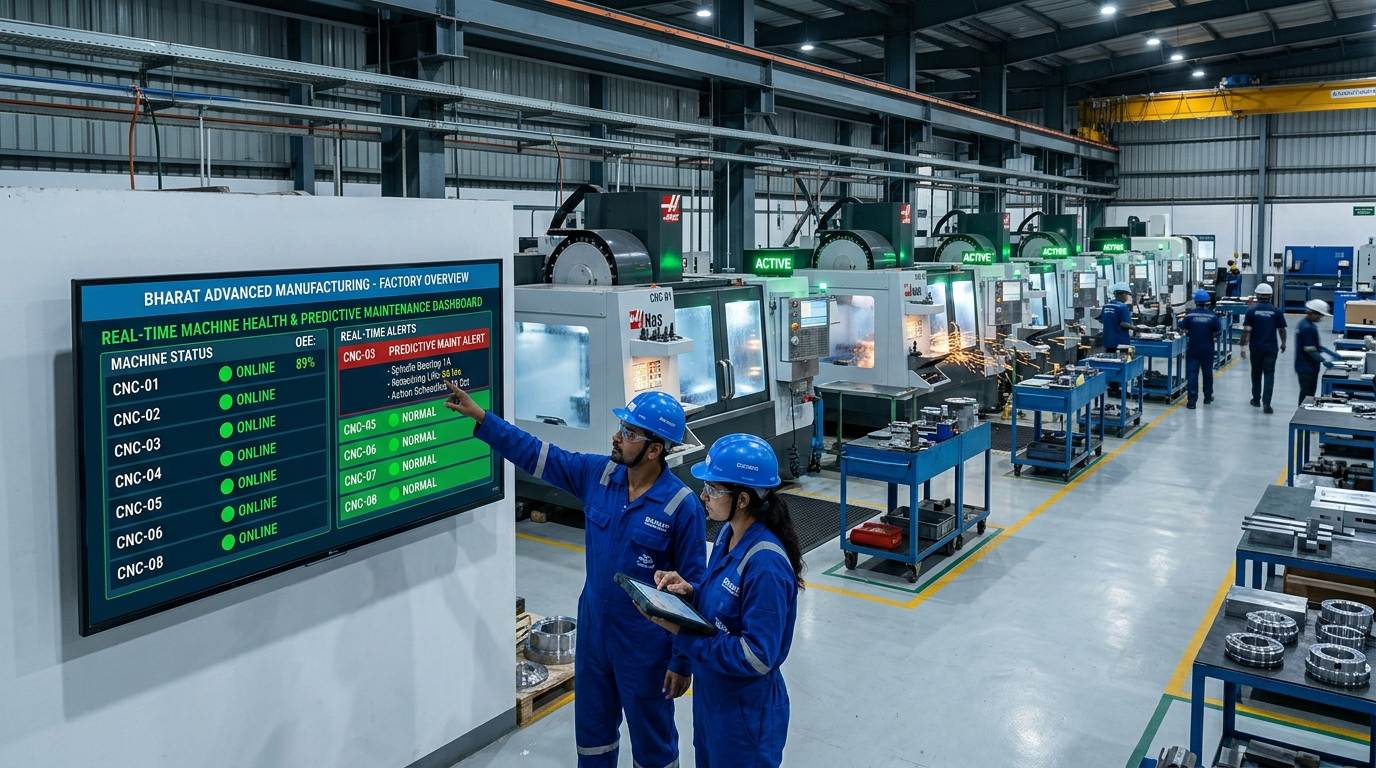
Haryana Precision Parts (HPP) makes brake components for three Tier-1 automotive suppliers. Their CNC milling floor runs 24/7. For six years, their maintenance strategy was the same as most Indian manufacturers: wait until something breaks, then fix it as fast as possible while the production line screams to a halt. In November 2025, an unplanned spindle failure on their flagship DMG MORI machine triggered a 9-hour shutdown that cost HPP approximately ₹18 Lakhs in production loss, emergency part shipping from Germany, and missed delivery penalties. That failure was the last straw. In January 2026, they deployed QBIQAL's Fault Zero — an AI workforce of seven maintenance intelligence employees. This is the story of what happened over the next 47 days.
Day 1: Planting the Sensors and Meeting the Team
The Fault Zero onboarding is deliberately non-theatrical. No massive installation crew, no weeks-long ERP migration. On day one, HPP's plant engineer, Deepak Suri, connected seven IoT sensor gateways to their critical machines. The gateways stream vibration, temperature, current draw, and spindle load data to QBIQAL's Cortex AI Engine every 15 seconds.
That evening, Deepak opened the Fault Zero dashboard for the first time and met his new AI maintenance team. His first interaction with Chowkidar Chacha — the AI employee responsible for 24/7 facility monitoring — was memorable:
"I typed 'check all machines' just to see what would happen," Deepak told us. "He came back in 40 seconds with a prioritized health report. Machine 7 showed early-stage bearing wear patterns. The machine had been running fine and nobody had flagged it. But the vibration signature was telling a different story."
Day 8: The First Prevented Failure (and the ₹4 Lakh Save)
Fault Zero's Chowkidar Chacha doesn't just monitor — he escalates. When his confidence score for a potential failure crosses 78%, he files a formal Maintenance Action Request in the Fault Zero Command Center, tagging the relevant equipment engineer and attaching an RCA (Root Cause Analysis) draft.
On day 8, he flagged Machine 7 for emergency bearing replacement. Deepak reviewed the recommendation, agreed, and scheduled a 2-hour planned shutdown for Sunday morning. The bearing replacement cost ₹28,000. The bearing they removed showed 60% wear degradation — it would have failed within 10 to 18 days.
A similar failure in HPP's history had caused a 14-hour shutdown. At their production rate, that is approximately ₹4.2 Lakhs in direct losses — plus expedited parts shipping. Fault Zero's first week paid for its annual license twice over.
The Predictive Scoring Architecture
What makes Fault Zero different from a simple threshold alarm system is its multi-signal reasoning. Rather than triggering an alert when temperature exceeds a fixed value, the Cortex Engine cross-correlates multiple streams simultaneously. Here is a simplified version of the scoring model:
def compute_failure_risk(vibration_rms, temp_delta, current_anomaly, runtime_hours):
    # Weighted risk scoring across sensor inputs
    v_score = min(vibration_rms / BASELINE_VIBRATION, 2.0)   # Capped at 2x
    t_score = max(0, temp_delta - 5.0) * 0.12                # Degrees above normal
    c_score = current_anomaly * 0.8                          # Current draw spike
    age_penalty = (runtime_hours / OVERHAUL_INTERVAL) * 0.3  # Age factor

    raw_score = (v_score * 0.40) + (t_score * 0.25) + (c_score * 0.20) + age_penalty
    return min(raw_score, 1.0)  # Normalized 0-1 confidence
Day 47: The Scorecard
At the 47-day mark, HPP pulled their first formal audit report. The numbers were stark:
• Zero unplanned machine stoppages across all 11 monitored assets.
• 6 planned maintenance interventions completed, all on Sundays, all under 3 hours.
• ₹15.4 Lakhs estimated in prevented failure costs (conservative model).
• Maintenance team's reactive emergency calls dropped from 18 per month to 2 (both electrical contractor issues unrelated to Fault Zero's scope).
"The biggest psychological shift," Deepak says, "was moving from anxiety to confidence. Before, I dreaded Monday mornings because a weekend could bring any surprise. Now I come in and Chowkidar Chacha has already sent me a Sunday evening summary. I know exactly what state every machine is in before I walk through the gate."
What Fault Zero Does Not Do (And Why That Matters)
Fault Zero is not a magic black box that replaces engineers. It does not physically repair machines, make procurement decisions above approved thresholds, or override safety protocols. When a recommended action exceeds a defined criticality level, Fault Zero automatically routes it to a human approver in Co-Pilot mode before any purchase order is generated.
This intentional limit-setting is central to how HPP built trust with their maintenance crew. The AI employees don't make the engineers feel redundant — they make the engineers faster, more proactive, and less stressed. Three of HPP's four maintenance engineers now spend 60% of their time on process improvement projects they never had bandwidth for before.
Concluding Thoughts
Fault Zero isn't just a software product. It's a fundamentally different philosophy about industrial operations: that machines should communicate their health status continuously, that human engineers should spend their expertise on prevention and improvement rather than firefighting, and that AI should handle the exhausting work of constant vigilance so teams can focus on the work that actually requires human judgement.
Deploy AI Workforces in Your Operations
QBIQAL provides robust, compliant, and ready-to-work AI specialists that interface with your booking, sales, and analytics systems seamlessly.