AI Employee vs. Chatbot vs. Automation Script: What's Actually Different?

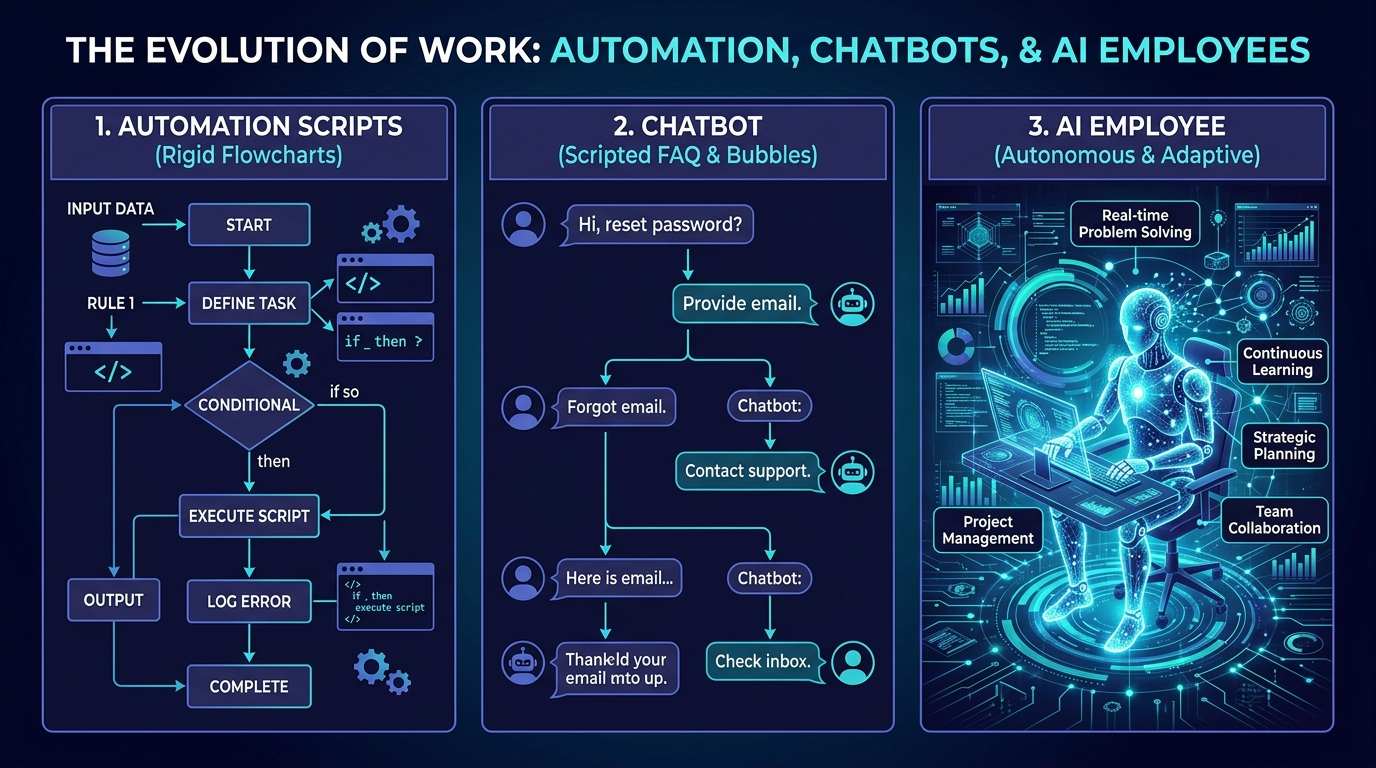
Every week, someone asks us a version of the same question: "We already have a chatbot on our website. Isn't Qbiqal just the same thing with a different name?" It is a fair question, and the honest answer requires a bit of context. The terms "AI employee," "chatbot," and "automation script" are often used interchangeably in marketing material, but they describe fundamentally different capabilities. Getting this wrong is expensive: companies that treat AI employees as chatbots consistently underutilize them, while companies that expect chatbot-level setup from AI employees end up frustrated. This article is a clear-eyed breakdown of the differences — written by Qbiqal's own CTO, who built all three before concluding that only one of them actually scales.
The Automation Script: Reliable, Brittle, and Limited
Automation scripts (and their visual-programming cousins, tools like Zapier and Make) excel at one thing: executing a fixed sequence of steps when a specific trigger fires. Email arrives in Gmail → extract attachment → upload to Drive → send Slack notification. This is deterministic, reliable, and fast.
But automation scripts have a fundamental ceiling. They handle only the inputs they were explicitly programmed for. If the email subject line changes format, if the attachment is named differently, or if the trigger arrives outside the expected window — the script breaks silently.
The other limitation is context. An automation script cannot read between the lines. It cannot understand that "this is urgent" means a customer is actually about to churn. It cannot escalate intelligently. It just executes a predefined path or fails trying.
The Chatbot: Better at Conversation, Still Decision-Blind
Modern chatbots, powered by intent classification engines or basic LLM fine-tuning, are a significant step forward. They can handle natural language inputs, classify query type, and retrieve appropriate response templates. A good chatbot can answer "What is your return policy?" in 14 languages, 24/7, without human intervention.
However, traditional chatbots have a critical architectural limitation: they are stateless and single-turn. Each query is processed in isolation. The chatbot does not understand what the customer told you last week. It cannot look up your CRM and see that this person is a high-value client on a trial plan who has been inactive for 12 days. It cannot take action based on what it learns from the conversation — it can only respond.
The most advanced chatbots available today can maintain a session context within a single conversation. But they still cannot access multiple real-time data sources, execute multi-step business workflows, or hand off to another specialized AI module mid-task.
The AI Employee: Reasoning, Memory, and Multi-Step Execution
This is where Qbiqal's architecture diverges from both previous categories. A Qbiqal AI employee has three capabilities that neither scripts nor chatbots possess simultaneously:
1. Persistent Context Memory: The AI employee remembers past interactions, customer history, and learned preferences across multiple sessions. When Aagam (our Lead Intelligence specialist) reaches out to a prospect, he knows the prospect's industry, last touchpoint date, and your agency's relationship history — without being told.
2. Multi-System Orchestration: A Qbiqal AI employee can simultaneously query your CRM, check a pricing database, run a calculation, draft an email, and log the entire decision trail — all as part of a single, fluid workflow. This is the Cortex Pipeline Engine at work.
3. Policy-Governed Autonomy: Unlike a script that blindly executes, or a chatbot that only talks, an AI employee operates within explicit guardrails. It knows when to proceed automatically and when to escalate to a human. This is not an afterthought — it is a first-class system design principle at Qbiqal.
The Technical Comparison
To make this concrete, consider a customer complaint scenario across all three approaches:
Scenario: Customer sends WhatsApp message:
"My order from last week arrived damaged.
 I want a refund OR replacement, not sure which."

AUTOMATION SCRIPT:
→ Checks if keyword "refund" detected → YES
→ Sends refund form link
→ END (misses replacement option, context, history)

CHATBOT:
→ Classifies intent: "complaint/refund"
→ Responds: "Sorry for the inconvenience!
   Please choose: [Refund] [Replacement]"
→ Awaits click → escalates to human
→ END (no CRM check, no policy engine, just routing)

QBIQAL AI EMPLOYEE (Biz Pilot):
→ Checks order history → finds order #4421
→ Reads damage photos sent 3 hours earlier
→ Checks customer lifetime value → HIGH PRIORITY
→ Checks policy: items <₹2000 = auto-approve replacement
→ Replies: "Hi, I've reviewed your order #4421.
   Since the item was ₹890, I've already processed
   a free replacement dispatching tomorrow.
   Your original order is marked as damaged for
   our quality team. Is there anything else?"
→ Logs in CRM, flags damaged stock batch
→ END
When Should You Use Which?
This is not a takedown of automation scripts or chatbots. Both have legitimate use cases. Here is how we recommend thinking about the choice:
Use automation scripts when: The trigger, path, and output are perfectly defined and never change. Think invoice generation, backup reminders, file transfer routines.
Use chatbots when: You need a high-volume, low-complexity FAQ layer, and the budget for a full AI employee is not justified. A chatbot on your contact page answering "what are your working hours?" is perfectly appropriate.
Use AI employees when: The task involves variable inputs, requires reasoning across multiple data sources, needs to escalate intelligently, and produces financially or operationally significant outputs. Basically: anything your human staff would describe as "requires judgment."
Concluding Thoughts
The AI employee category is genuinely new. It is not a rebrand of the chatbot industry. At Qbiqal, we spent two years building the architecture that makes this possible — a multi-model reasoning engine, a secure multi-tenant pipeline executor, and a human-in-the-loop governance layer that companies can trust. The next time someone tells you their chatbot "does the same thing," ask them if their chatbot knows your CRM history, can execute a 13-step workflow, and will escalate intelligently before spending money on your behalf. That answer will tell you everything.
Deploy AI Workforces in Your Operations
QBIQAL provides robust, compliant, and ready-to-work AI specialists that interface with your booking, sales, and analytics systems seamlessly.